The fall of Constantinople and the 16th century debates about the shape of the city's occupation
 (4 years ago)
The small town named Byzantion, founded in the century. (c. II B.C.E.) will join the cities ruled by the Roman Empire. Although Byzantation had a high geostrategic advantage, it did not attract the attention of Roman emperors. Things differ with the coming to the throne of First Constantine (324-337), [...]
The small town named Byzantion, founded in the century. (c. II B.C.E.) will join the cities ruled by the Roman Empire. Although Byzantation had a high geostrategic advantage, it did not attract the attention of Roman emperors. Things differ with the coming to the throne of First Constantine (324-337), which in the month of May 330, an atmosphere of celebrations lasting four days, the imperial residence of Rome will shift it to the coast of the Bosphorus. Thus, even officially, the small Byzantine will be transformed into the center of the world. But now by its new name, Constantinople, also identified its new owner, Constantine. From here on, Constantinople, the capital of the Roman Empire for 1123 years, will be the heart of civilizations where Christendom's sectarian wars will take place right there.
As Constantine ʹ born in the space of Illyria (Nish) may have thought, known for combat strategies and pragmatism for the benefit of the masses (as is the case with the recognition of Christianity) ) the ancient town of Byzantation was set up in the Bosphorus Strait, surrounded by the sea and the Golden Briri/Kip. There were favorable conditions to resist the storms of conquest. So, rather than by chance, this fortified city on Constantine's part stood up to the numerous sieges made by the armies of the Arabian dynasty and the Ottoman sultans. He remained steadfast to the invention of new technology, such as the ball, that he managed to undo the protective walls in 1453.
Constantinople's Zaptim was the Latinist (Christians of the West), Arabs, Hungarians, Serbs, pechenics, Turkish tribes, and so on. However, the first conquest was made by Latin crusaders on April 13, 1204. According to N. The Akominat, the <x0th city of glory, was already nothing but despair, tears, screams and moaning”. This anger expressed in violence resulted from the sectarian war between two Roman centers (that East and West) divided into religious sects. The second conquest was that in 1453, when the Ottomans led by Sultan Mehmeti II was forever subdued.
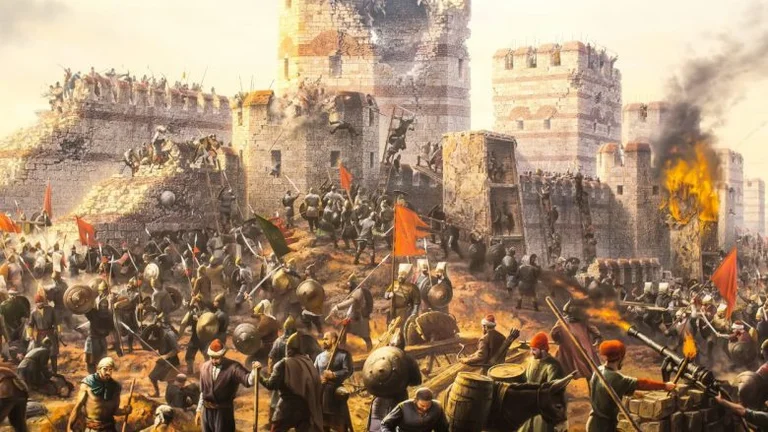
Mehmet II's biographers claim that Sultan was just as strategist as the builder (Kostandini). This man had been studying the advantages of the imperial city. And, on these findings, he also made the landing plan. Initially, he built the Rumeli Hissar forts (10 miles north of the city, on the European side of the Bosphorus, where he takes over sea routes to the Black Sea and secured the way for the penetrate of Ottoman troops from Anandol to Europe (August 1452). Immediately after completing the fortifications, Mehmet urged the city to surrender, otherwise it would face siege and full flow. Then he returned to the Ottoman capital (Edrene) and began researching the invention of technology for the detoxification of the centuries-old and unbreakable walls built by Emperor Teodosi II. With this issue, the great master of Hungarian descent, Urban, was hired, and all in the end, after making preparations for the march to the city, renewed the Pacific Agreement with Venice's naval state and signed an act of peace with the Hungarians. On March 23, 1453, on Friday, the Ottoman army marched toward Constantinople. Sultan Mehmet took a total of 54 days of siege and war to break the defense and conquer the imperial city, which was protected by the Byzantine emperor Constantine XI himself.
The sectarian divisions were evident since the church was divided, but in 1439 the Byzantine emperor, in exchange for the aid Rome would offer, acknowledged submission to the latter by promising the union of Catholic and Orthodox churches. Patrick in Constantinople and his followers and followers reacted harshly to this decision, which they called humbleness to the humiliation of the Roman church. However, this would not prevent Patrick Georgios Scolarios from leading some 30 thousand of his followers in the defense of the city along with a small formation of Catholic Christians from Naples under the church union agreement. One of the military formations coming from the West, which played a key role in protecting the city, was that Giovanni Giustinian Longos, who along with 700 professional fighters had come in January 1453 and was one of the designers of all defence strategies.
Byzantium's number of professional fighters was about 9-10. And within the walls were 30 thousand of the patriarch's faithful, as well as a formation of 100 men led by Orhan Chelebiu, an Ottoman prince who had taken refuge in Byzantium. The sultan's professional army, however, had about 70 thousand. It is noteworthy that the sultan was also helped by military and professional formations by peoples in the areas of Anadol and Rumelli (modern - day Balkans) who were under Ottoman vassality. P. sh. The ruler of today's Kosovo space had sent 1500 miners who contributed to the opening of tunnels under the city's walls.
On April 6, 1453, Constantinople will face its first and most powerful attack. For the first time, Sultan used the improved ball by the great Hungarian master Urban. This new technology, in addition to the destruction on the walls, became a cause of panic and moral loss to defenders, in particular to volunteers from the common population. Then, by the 11th, different batteries of combat cannons are used. And on April 18, Ottoman armies marched toward the city from far and wide. Defense has succeeded in this attack. This failure caused moral decline in the Ottoman army. Nine days later, on April 20, 1453, three Gardening warships and one Byzantines managed to break down Ottoman forces at the Golden Horn and supply the city with food.
This failure by Ottoman forces caused the arm of Ottoman bureaucratic leaders, Candarli Halil Pasha, to seek once again a retreat from the goal of subjecting Constantinople. At this point, when Sultan had to make the difficult decision, continuing or withdrawing, moral support comes from the Islamic scholar of the day and his personal teacher, Aksten. He writes a letter to the solitary indictment that has been preserved down to this day. In this letter, containing Koran verses and glorious history of Muslims, it required that all who did not wage war in vain and were replaced with the right ones be punished. All at the end of the letter, he wrote that to overcome the frustration of the attack, he had read portions of the sacred book, the Koran, then fallen asleep. In his dream, he was shown some glad tidings, which suggested to the sultan that this dream was a sign that the city mentioned even in the prophet Muhammad <x0 most blessed commander and the most blessed army was going to release Constantinople” All at the end of the letter, he was ordered to proceed as planned.
After that, Mehmet, with the goal of boosting morality to skeptics, decided that from land to land to carry 60 ships over Galata hills to Halic (Golden Maker). The movement caused the Byzantine success of April 20th to turn into panic and fear. However, the duration of the siege and stay in the country favoured the opposition arm of Ottoman bureaucratics, who continued with sabotages. This time they will also use the threatening visit of Hungarian representatives who had come to the war headquarters to announce that if they do not withdraw from the siege, a Christian army will march toward Constantinople. Although this threat has not been taken into account, the Byzantines managed to spread news within the army that the Christian army had already taken its way to Rumeli.
At these critical moments for the sultan, who was accused of spending his state's military and economic power on his own whims, will support del Zaganos (Zognos) Pasha (the Italian sources show that he is of Albanian descent, and this claim is supported by Halil Inalcik, who says he was from Vushtrria), and thus Sultan demanded from the (Albanian) testament to draft the plan for the final attack. So the decision was made to make the attack on May 29th.
This attack made Mehmet II's dream come true to take the city of one of Rome's most prominent emperors. With the city's subjection, the Byzantine Empire, Constantine XI, was heroicly defeated. The Emperor's fall from here on Mehmet II to get epithesia “Fitah” (Convince) and this as a result of the taking of the Byzantium crown as well as the conversion of the main church of Eastern Christianity, Aya Sophia. The act of transforming the main church into mosques was symbolic of Islam's triumph over Christianity, as it also marks the end of the Roman Empire in the East.
Sultan Mehmet II is considered one of the greatest statesmen in history and the most prominent of those Muslims. From the composition of literature found in his personal library, it is implied that he was an excellent connoisseur of ancient languages, had read works from the history of the prophets, Leka the Great, stories of emperors, philosophy, and natural science, and, of course, had well studied Constantine's purpose and vision in relation to the rebuilding of the imperial city. So Sultan did not destroy the city, as did the Latin people in 1204. Rather, he also made sure to keep it legal. So not by chance did this city just become more cosmopolis than it was. No people (racial and religious distinction) were exempted to be part of Istanbul's trade and dynamic. As long as you remember the names of professions by the name of Arnavu/Albanian, it's like it comes with cobblestone, gigari annavousus, and so on. (Take Arnavu/Albanian appointments, because it was professions and foods that identified Albanians) with and so on.
As all the sources of time suggest, after Sultan entered the city, he allowed the spoil for three days (but not even the demopolation); he promised residents the right to life and exercise of the former faith. As a center of the Patriarchate, he appointed the Church of Apostles, but later, in 1455, Patrick Gennadius asked to pass to the Pamacaristo Monastery. Since the Church of Apostles remained empty, in 1490 Muslims seek to convert it into a mosque. But the fact that these monasteries and churches were not common in sanctification had not been approved.
Despite this, the question of churches and monasteries takes a turn at the time of the rule of First Selim (1512-1520). This time, this issue was raised by Muslim fanatics who, influenced by Ottoman-Safavid wars, demanded the closure of active monasteries in Istanbul. The issue was asked by Patrick Theolep the First to testify by decree (the rights) that Sultan Mehmet II had recognized about churches and monasteries. Patrick found these makings may have been burned and proposed that statements from some living soldiers who had been part of fighting in Istanbul be taken into account. After these statements of witnesses, the statute of cult objects was again preserved.
The debate over the Pamakaristo Monastery is re-entered at the time of First Sylejman (1520-1566). This time, doubts were raised in connection with how Fatihu, Istanbul, war or peace deals? Thus, the case also takes on a judicial dimension that was issued by a Fetfa/the thought of Shajhulslam/the greatest diary of the time, Abu Suud Efendiu, who is also known for drafting all Ottoman legislation.
The question that called for Shajullislam's opinion was: “Sultan Mehmet, the city of Istanbul, along with its surrounding villages, took them to war”? The answer was: the mentioned “Zonas were taken to war, but the existence of the old churches means that (this area where the church/mansatarire is found) has been delivered in peace”. Thus, critical voices requiring the closure of churches and monasteries in Istanbul of the XVIth century were extinguished.
Despite the pro and controversial debate conducted over the centuries, detailed modern studies based on written arguments and those on the ground testify to the fact that Istanbul fell to the Ottomans after a long war and that we do not have any peaceful agreement. The Islamic scholar's view was in accordance with the right of Islamic law enforcement for interreligious co-existence, while non-myslymians respected the rights and laws set aside in Sheriat-based canons. On the other hand, the existence of the activity of churches and monasteries at the time of Sultan Mehmet II also testifies to the Sultan's vision of maintaining religious harmony in the city, which will be the chief center of the Ottomans for 470 years and 407 years the center of Islam Kaliphate.