Kidnapping the prime minister/ Can we boast that we have foreign investments in Kosovo
 (4 years ago)
The increase in foreign investments in Kosovo, trumpeted by Prime Minister Albin Kurti, has had no observable effect on the economy, experts in the field say. Kurti, after marking the anniversary of the government on March 22nd, has said this was the year of “economic development and investment”. “Foreign Direct Investments, compared to year [...]
Kurti, after marking the anniversary of the government on March 22nd, has said this was the year of “economic development and investment”.
Foreign direct investment, compared with 2020, has increased by 21.8 percent, while by 2019 65 percent”, he said.
According to Kosovo Central Bank data, foreign direct investments in Kosovo in 2021 have had the value of 421m euros compared to 345m euros in 2020 and 254.8m euros in 2019.
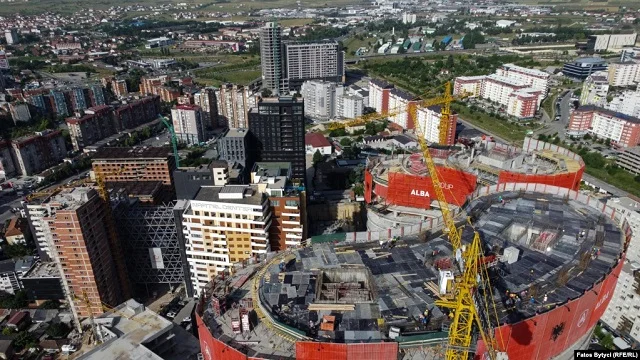
Out of the amount invested last year, 383.9m euros have gone to the real estate sector.
Former Kosovo Trade and Industry Minister Ismet Mulaj tells Radio Free Europe that the real estate sector brings at least the effects on economic development and the generation of new jobs.
We cannot boast that we have foreign direct investments in Kosovo. Foreign investments that affect economic development and generate jobs are in the production and services sector. These are strategic sectors, where Kosovo has the interest to attract investors”, Mulaj says.
But the production sector in Kosovo is among the most underdeveloped.
Kosovo is importer of almost all products. In 2021, the value of exported goods has reached about 750m euros, while imports have reached over 4.5 billion euros.
The chairman of the Afarism Oda in Kosovo, Skender Krasniqi, says the offer is missing, both for foreign and local investors.
Various from what Kosovo institutions claim is the situation on the ground. We have investors who are interested in investing in Kosovo, [but] lack of a real offer, lack of determination for legal and security infrastructure for investors, causes them not to come to Kosovo”, Krasniqi tells Radio Free Europe.
According to him, foreign investments in the real estate sector are largely attributed to the Kosovo diaspora, which, as it says, invests large sums of money in building houses and buying apartments.
According to Kosovo Central Bank data, Germany is the state with mostly foreign direct investment, followed by Switzerland. These are two states, where the largest number of citizens from Kosovo live.
Experts say impacts on economic development and the opening of new jobs have investments in the service sector, agriculture sector, energy sector, mining, transport and telecommunications, and tourism.
Mulaj says that Kosovo, although small, has potential.
According to him, the country's new population can generate workers for any industry that could develop in Kosovo.
Kosovo is the third country in the world for coal reserves and we have not yet managed to attract investors who can use coal for various products. Coal is not only used for heating or supply of thermal power plants. More than 36 products that are not related to environmental pollution can be created from it, but are of interest in Kosovo development”, Mulaj says.
Prime Minister Kurti, at an American Economic Ode meeting on March 24th, has pledged that, in co-operation with the economic efforts operating in Kosovo, he will create policies in favour of the rapid and sustainable growth of foreign direct investments.
He has said he is also considering the possibility of recruiting economic attachés to over twenty different countries in the world.
Their role, according to Kurti, will be to create investors' lists, bring them to Kosovo and, then, the government together with the economic efforts to convince them to invest in Kosovo.
Kosovo, if compared to the countries in the region, such as Albania and Serbia, has much less foreign investment.
According to the United Nations Trade and Development Report, in Serbia, foreign investment through 2020, $3.4 billion has been introduced, while $1.1 billion has been invested in Albania.
As reasons for lack of investment, complicated legal infrastructure and energy uncertainty have often been mentioned.
In a report published in 2020, the US Department of State for Investment Climate has said that “one of the problems preventing foreign investors from going to Kosovo is the unreliable supply of energy”.