7 hours ago
French Ambassador: Association is a second Republika Srpska, Kosovo pledged to do it
Periskopi(4 years ago)
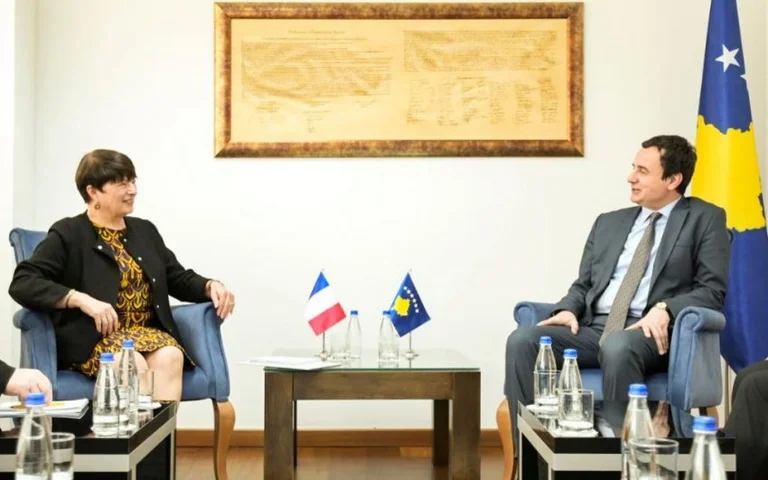
(4 years ago)France's ambassador to Kosovo, Marie Christine-Butel, in an interview has spoken on the issue of visa liberalisation, the agreement for Association and the process of dialogue with Serbia, and the final agreement between Pristina and Belgrade. Buttel has shown that France is one of the sceptical countries for liberalisation and has stressed that this scepticism is linked to fear [...]
France's ambassador to Kosovo, Marie Christine-Butel, in an interview has spoken on the issue of visa liberalisation, the agreement for Association and the process of dialogue with Serbia, and the final agreement between Pristina and Belgrade. Bhutel has shown that France is one of the sceptical countries for liberalisation and has stressed that this scepticism is linked to fears of potential migration that could be caused if the visa regime for Kosovo is removed. The Serbian Communists Association says it is an agreement Kosovo has pledged as a serious state to implement as long as it points to a “Republika Srpska” second, nor to the component of the functioning of the state of Kosovo. For the outcome of the final agreement, it stresses that it is up to Kosovo and Serbia to agree, until it mentions the period 2022-2024 as time Pristina and Belgrade must use it to reach a final agreement.
President Macron has promised that during this six-month period, while France will lead the European Union presidency, special attention will be given to the Western Balkans. He has also promised a conference for the region. What specifically can the region expect during these months?
Marie Christine-Butel: During a media conference on December 9th of last year, regarding the main orientation of the French Presidency of the European Union Council, President Macro stressed that it would be singled out on two geographical priorities: Africa, in the southern neighbourhood of Europe and the Western Balkans, because more than neighbours, the Western Balkans are in the heart of Europe. That is why a conference for the Western Balkans is scheduled in June, which will not be an EU Samit Balkans, already planned by the Czech presidency in the second half of the year, but an event gathering leaders of member states and European institutions, as well as representatives of civil society to address common problems.
Kosovars now and several years look to the European Union on the issue of visa liberalisation. The European Commission has repeatedly repeated that Kosovo has met the conditions. Meanwhile, official Paris is still not lighting the green light to support Kosovo on this issue with the reason that conditions have not been met sufficiently. How likely would France's approach change, and could it happen before April's presidential elections?
Marie Christine-Butel: Under the visa liberalisation process, the EU Commission defined a list of technical criteria which it considered had been met by Kosovo and which, in fact, important reforms had been made to achieve this. This step is important, but not enough. Indeed, it must be stressed that the short-standing visa decisions and therefore access to the Schengen area are of a political nature and, for this reason, belong to the governments of member states meeting within the EU Council. It must be determined that those decisions are made not by consensus but by qualified majority, which means only one state cannot block them.
As for visa liberalisation for Kosovo, it is true that France is one of the states, along with several others, which has expressed reservations, because these states are concerned about the risks, especially those of migration, that could be caused. Therefore, it is important for Kosovo to prove that concrete measures have been implemented for putting these risks under control and that tangible results have been achieved, both in terms of preventing illegal migration and in fighting corruption and serious crimes.
Can France be expected to put the visa liberalisation issue for Kosovo in order on the EU Council of Ministers?
Marie Christine-Butel: Given the international context, the agendas of future councils are likely busy, and some decisions may be difficult to make by member states.
Concretically, this means that, as far as visa liberalisation is concerned, involvement in the EU Council agenda from France or any other state that will lead the presidency can be considered (presented/planified), only if there is security that the majority required for a favourable decision has been reached.
Kosovo dialogue Serbia is one of the issues France has made an active commitment, especially during 2019-2020, when there was a Macron-Merkel co-ordination. We remember the Berlin and Paris Summit. However, there is already no such effort to help the EU. Can something similar be expected in the future?
Marie Christine-Butel: France continues to be very committed to the issue of dialogue between Kosovo and Serbia. It supports the mediation of European Union Special Representative Miroslav Lajčak. She has witnessed her commitment by organising, along with Germany, two summits in 2019 and 2020. France is always willing to work in this direction once Kosovo and Serbia engage in implementing signed agreements and will provide concrete evidence of their will to advance the dialogue.
Currently, the Kosovo dialogue -- Serbia is stuck. EU High Representative, Mr. Borell, has said that, at the moment, Kosovo is expressing a lack of desire to sit at the table of dialogue. Have you had the chance to talk to Mr. President? The stage why this refusal to return to negotiations is emerging, and do you see it as dangerous to continue the status quo?
Marie Christine-Butel: Dialogue has no alternative; it is a matter of security and prosperity for Kosovo and Serbia, for the region and for Europe as a whole. I am convinced that all parties are fully aware of this.
One of the very controversial issues is that of establishing the Association of Serb-run municipalities. Do you think that it should be established and what is your answer for those who fear for a second “Republika Srpska”?
And if Kosovo refuses to establish it as the Constitutional Court's decision, like France, has there ever been any modalization in the issue of association or can you expect to propose any one for how to establish association so that there is no danger of repeating what is happening in Bosnia and Herzegovina?
Marie Christine-Butel: Under the most common international rule of law, with the signing of two agreements in 2013 and 2015 for Association/Recognition of the Serb-run municipalities, Kosovo has taken over to implement them as a sovereign and responsible state. Meanwhile, the two signed agreements leave much room for Kosovo authorities to determine the legal framework, status and manner of functioning of this entity. Already from these authorities, and only of them are expected to make proposals in this regard. But there is no way to compromise the proper functioning of Kosovo institutions, nor the creation of a new “Republika Srpska”.
Serbia's final Kosovo agreement, according to you, what should it look like? Do you rule out any changes in the borders and should mutual recognition of Kosovo be included within the final agreement, Serbia?
So, the EU, when it speaks of the Pristina final Belgrade, consistently highlights the term “comprehensive agreements legally binding” and does not mention mutual recognition. Meanwhile Washington clearly says it. Do you see danger if mutual recognition does not occur under this agreement?
Marie Christine-Butel: The final agreement will be the result of negotiations between Kosovo and Serbia. It is up to both sides to define its contents according to the points they have agreed on, with the goal at least to be comprehensive, final, and legally binding.
According to you, when would it be ideal for Kosovo and Serbia to reach a final agreement and do you believe that the lack of a timeline for the parties is causing difficulties and delays in the process?
Marie Christine-Butel: After the elections in Serbia in April, there will be a two-year period Kosovo and Serbia will have to use to reach an agreement before European elections in 2024 and elections in Kosovo in 2025. There is no need to set deadlines to see that when such an opportunity arises, you need to use it and do everything to achieve a result. /Express/