Donbass condemned fighter at barricades in northern Kosovo
 (3 years ago)
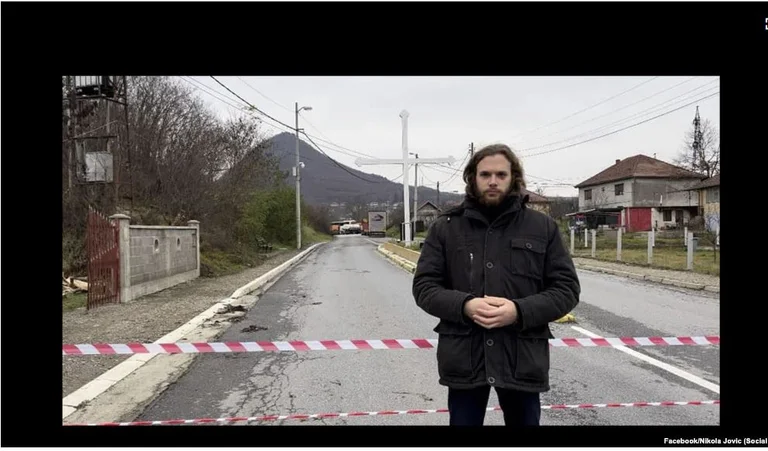
Days after several local Serbs blocked roads in northern Kosovo, barricades were visited by a Serb national convicted of participation in Russian forces during the war in Ukraine in 2015. Nikola Jovic, who was sentenced by the Supreme Court for participating in the war in Ukraine, action that Serbian law condemns, [...]
Nikola Jovic, who was sentenced by the Supreme Court for participating in the war in Ukraine, action that Serbian law condemns, has published on Facebook photos from the village of Rudare in Zvecan municipality in northern Kosovo.
In this country, trucks from some local Serbs have been used to block the road for several days, in a sign of discontent following the arrest of their countrymen and former Kosovo Police Minister Dejan Pantic.
Pantic was arrested on December 10th, after Kosovo authorities suspect he participated in the attack on the Kosovo Central Election Commission office.
Joviqi has said he went north of Kosovo as a reporter of Russian state media Russia Today (RT). In his photos published on December 13th, there is a NATO Mission car in Kosovo, KFOR, Serbia's flag in the courtyard of a house, as well as a tent set up by some local residents in the village of Rudare.
Jovic has also published a photo of himself in northern Mitrovica in Kosovo.
“on the barricades. Always with my people”, Joviqi wrote alongside published photos.
In one of Jovic's photos, the symbol of Ukraine's Russian military invasion “Z” is also seen in Kosovo.
He has also posted on Facebook how he reports from Kosovo as Russian state channel correspondent Russia Today (RT).
RT began broadcasting online in the Serbian language on November 15th with the message “Kosovo is Serbia”.
RT, as a media controlled by the Kremlin and funded by the state budget, has been banned from broadcasting into the European Union since March 2022.
This medium has been named a key tool in spreading Russian propaganda and has become the target of a package of sanctions against Russia for the war in Ukraine.
In October, Jovic announced on Facebook that he was barred from entering Bosnia and Herzegovina. REL has not received answers from Kosovo Police if Jovic has been allowed to enter Kosovo.
Radio Free Europe tried to get information from Jovovic about his position in Kosovo, but he refused to answer questions.
In a Facebook reply, he cited dissatisfaction with the REL's earlier writings for reasons.
“Support for Serbs” and reporting from northern Kosovo
On December 13th, Jovic conveyed the message to Facebook that it is important that we be there with our brothers” with the symbol of the Serbian flag, as well as that it will be “safe for several days further”. “in Kosovo.
In another December 11th post, Jovic announced his employment in the Russian state channel RT, in which he speaks in English about the situation in Kosovo.
In his report on RT, he describes events in northern Kosovo as “the adoption of” of Kosovo Albanians and prime minister Albin Kurti, who, according to him, is trying to impose his will on Kosovo Serbs.
In a Facebook post, he wrote he is using his “position as international service correspondent RT” to inform “the world of the situation in our southern province and of continued terror against Serbs” in Kosovo.
Kosovo declared independence in 2008, but official Belgrade does not recognise it as an independent state. With Russia's help, among other countries, Serbia is blocking Kosovo's membership in international institutions.
The official Kremlin blames the European Union for the recent tensions in northern Kosovo for, as Russian Ministry of Foreign Affairs spokeswoman Maria Zakharova said, “a major lack of mediation in the stalled” dialogue.
The EU has been mediating negotiations between Serbia and Kosovo since 2011 and regularly invites representatives of the two countries to meetings in an effort to normalise relations and eventually mutual recognition.
The Spread of propaganda
Predrag Petrovic, director of research at Belgrade's Centre for Security Policy (BCBP), tells Radio Free Europe that Jovic's presence at the barricades in itself does not pose a security risk, however, he points out:
The “that can present a security challenge is how those news will be broadcast further, especially in pro-Russian and extreme-right channels. The very fact that he was there can be used for propagandistic purposes on those channels,” says Petrovic.
In the question of how much Serbia's state capacity is to deal with returnees from the battlefields outside its territory, Petrovic says competent institutions so far have shown no interest in resocialising these people.
Even people who went to fight against Bashar al-Assad's regime (the Syrian president) in Syria have remained in their hands, namely, the local community for resocialisation. The same applies to those who went to the Ukrainian battlefield”, Petrovic says.
Condemned Journal
Jovic, as REL reported earlier, announced in September through his Facebook account that he had travelled to the Donjeck and Luhansk regions in the region of Donbass in eastern Ukraine, publishing photos with several soldiers in uniform.
He later declared that he had traveled as a journalist.
Joviu was introduced in the same role in September at a forum in “The Russian Home”, the Russian Centre for Science and Culture in Belgrade, where it spoke of Ukraine.
However, Jovic had previously not gone to Ukraine as a journalist, but as a war participant.
REL has secured the Supreme Court's decision in Belgrade, in which, among other things, the Donjeck People's Republic” paramilitary formation in eastern Ukraine reportedly joined.
“Briga of Seven” is a pro-rus formation that is on the side of separatists.
The trial is said to have used an automatic rifle and fled Ukraine in April the same year. Jovic was convicted in court.
He was sentenced to one year in prison on bail because participation in war in a foreign battlefield in Serbia is a criminal offence.
In parts of eastern Ukraine, Donjeck and Luhansk in the Donbas region, Moscow had encouraged a separatist uprising in 2014, and fighting has continued since then in that part of Ukraine between Ukrainian forces and pro-Russian separatists.
Joviki had told him earlier REL that being a fighter in the war in Ukraine is no obstacle to his journalistic work.
Because I've been to Donba several times in these seven years as a volunteer and a journalist, I can see the subject and issues from many sides and angles”, he had said among other things in his answer to REL in September.
According to estimates by the Ukrainian Embassy in Serbia, more than 300 citizens have left Serbia from December 2018 to fight on the pro-Russian side.
For participation in the war in Ukraine in 2015-2018, 32 sentences have been pronounced in Serbia. In 28 cases, the court has sentenced the defendants to prison on bail, while four persons have been sentenced to house arrest for six months.
Support of right-wing organisations for Serbs in Kosovo
On December 11th, Jovic published on Facebook an invitation for participation in a right-wing protest that was organised in front of the St. Sava church in Belgrade on 12 December, in support of Serbs in Kosovo.
The organizers of this gathering were disguised and refused to reveal their identity.
The video from this protest has been distributed to Telegram by the Russian paramilitary group “Vagner”, which the European Union (BE) has placed on the sanctions list. This unit, according to the media, is made up of trained mercenaries willing to participate in wars worldwide.
Western governments accuse Moscow of using the “Vagner” as paramilitary force in the conflicts of Ukraine, Libya, Syria, Sudan, Mozambique and the Central African Republic.
This unit holds an active role in the Russian Army even after the start of the Ukraine war.
In their channel at Telegram, they also report closely to the crisis in northern Kosovo, where trucks and buses are blocking roads, preventing circulation towards border points with Serbia, Jarinje and Brnjak.
These barricades were erected after the arrest of former Serb national police, Dejan Pantic, but tensions in Kosovo began earlier, in early November, when Serbian judges, prosecutors and administrative staff in northern Kosovo left Kosovo institutions.
On 15 December, authorities in Serbia demanded from KFOR the return of Serbian security forces to Kosovo, based on UN Resolution 1244.
US Special Envoy for the Western Balkans Gabriel Escobar said in an interview REL on December 13th that it officially rejects that requirement.
Peacekeeping Mission NATO in Kosovo, KFOR, said on the official Facebook page on November 13th that the only way for lasting peace is to resolve the issue through dialogue between Pristina and Belgrade, respecting the rights of all communities.