6 minutes ago
A major defeat by Parliament Speaker Glauk Konjufca
Periskopi(4 years ago)
(4 years ago)The Constitutional Court's Act on Decan Monastery Lands, according to Glauk Konjufca, should be revised once again. First by AKI (Kosovo Intelligence Agency), and then the court's legal opportunity is exhausted. But where will Glauk Konjufca find the court, which values the decisions of the Constitutional Court of Kosovo? Glauk Konjufca, as Chairman [...]
Glauk Konjufca, as Kosovo Parliament Speaker, seems to lack basic legal knowledge of how the judicial hierarchy works in a state that implements right and law.
At least that impression left on a television show.
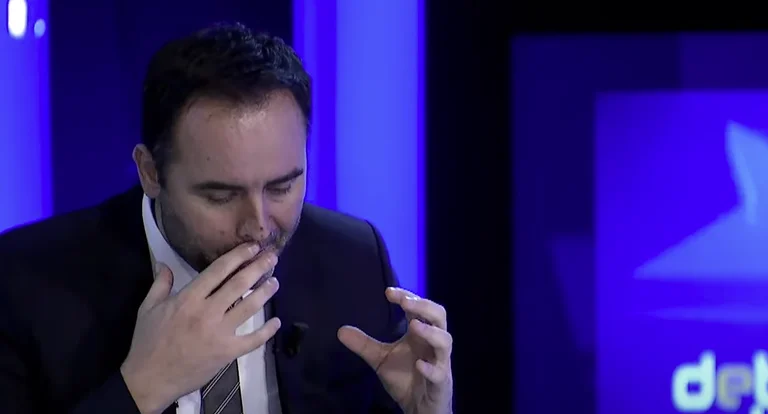
Konjufca, a few days ago, was a guest on TV Dukajni, and among other things, was asked by panelists about not implementing the Kosovo Constitutional Court's decision on the Decan Monastery grounds.
“What will you do with great international pressure on you to enforce the Kosovo Constitutional Court's act on land around the Decani Monastery?
In his answers, reflecting uncertainty and lack of knowledge about how this Constitutional decision will be carried out, Konjufca spoke as if through the mist.
The Speaker of the Assembly, pours out his ignorance, let us believe in purpose, not knowing the burden of the Constitutional Court's judgments.
Konjufca assumes that the Constitutional act before it is implemented should be re-visited once again, “first by AKI (Kosovo Intelligence Agency), then exhausted judicial opportunity in court”.
It is not ruled out to be part of any strategy of the party that concerns Konjufca, VVA, to find ways to undo implementation of the Constitutional decision.
But which court in Kosovo can I assess or contest the legality of constitutional decisions, when the latter is the last and supreme authority for interpretation and law enforcement? To be even clearer, there is no other court on the Constitutional Court in Kosovo's judicial system.
The inequity of its decisions, for which Conjufca appears to play toke, guarantees Kosovo's Constitution.
In Chapter V III was, Article 112 of the Constitution, clearly states that the “Constitutional Court is the final authority in the Republic of Kosovo for interpretation of the Constitution and the compliance of laws with the Constitution”.
The following is your transcripted from the Konjufca interview where he answers about the Constitutional decision for Decanin:
Journalist: What will you do with great international pressure on you to enforce the Kosovo Constitutional Court's act on land around the Decani Monastery?
Conjufca: It's a big problem, it's true. I think that if proven in two dimensions that has been the uncondicted decision by these two dimensions that I'm trying to explain, I think that the state and the government of Kosovo don't cry without doing it.
There's a lot of persistence they can do. I think that from the constitution of Kosovo, to the instance of courts in which no legal opportunity has been exhausted, as in Kosovo's constitution, I think that if it is definitely proven that there are no external and external influences, even from Serbia to the decision of the Constitutional Skykat, the first one, and second if there is no procedural violation in the principle that our terms are protecting, well, in an experiment, protecting the depletion of legal means, I think the government has nothing to do without implementation.
Journalist: What is that instance over the Constitutional Court?
Conjufca: Now in the sense of Kosovo's trial and institutional adjustment, it is clear, that we are to be superior, the superiority of the Constitutional Court and so on, but if there are other side indicators that can be followed by facts and evidence, and then that takes another path, which also goes from security institutions and ends up in justice and is argued that there have been major defects, and I think it's in everyone's interest after the transition of the hail.
I can't believe I can't share all the information with you.
Which Is the dispute over the land of the Decani Monastery?
In 2016, Kosovo's Constitutional Court has ruled in favour of the Decani Monastery, or determined that 24 hectares of land belong to that monastery. The court found that there have been violations of Article 31 of the Constitution of Kosovo, connecting with Article 6 of the European Convention on Human Rights.
However, local power in Decan refuses to implement this Constitutional Court decision because, as it claims, that property is the property of social companies “Apico” and “Iliaria” and that it has never been of the monastery.
Local authorities in Decani also believe that the Constitutional Court legalised Slobodan Milosevic's decision from 1997, when it decided to donate this property to the monastery.
On the other hand, in the act of the Constitutional Court, which gives the right to the monastery's claims, those lands were said to have been expropriated by the Decani Monastery with a decision by the <x0st) The Executive People's District for Kosovo and Metohija”, headquartered in Prizren shortly after World War II, in 1946.
Do not follow through on this decision, Kosovo has been brought into conflict with the international community.
The United Kingdom and the United States of America, in a joint letter months ago, have expressed concern over the failure to implement land registration of the Decani Monastery in line with the 2016 Constitutional Court's ruling
According to them, failing to comply with this decision and other court decisions undermines the Government's pledge to enforce rule of law and its respect for independent judiciarys. /Periscope
https://www.youtube.com/watch?v=rkSaH5ASOE