Merkel gathers prime ministers of Western Balkan countries for the last time today
 (5 years ago)
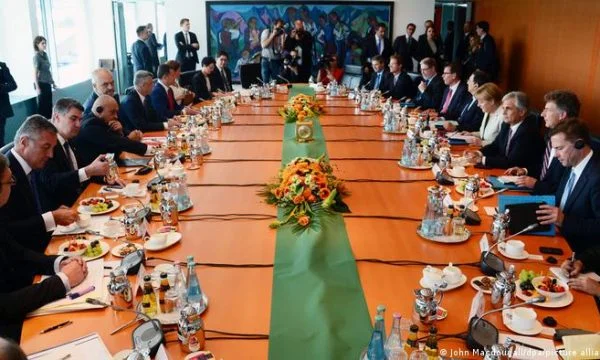
Germany's Chancellor Angela Merkel will talk to the prime ministers of Western Balkan countries under the Berlin Process, one of its most important foreign policy initiatives today. “This was German Chancellor Agela Merkel's last word at the [...] press conference.
“Switch! ” This was German Chancellor Agela Merkel's last word at the Summit press conference in Sofia in November 2020. It addressed the two organisers of the sixth summit of the Berlin Process, the prime ministers of Bulgaria and Northern Macedonia, Boyko Borisov and Zoran Zaev.
Despite the friendly atmosphere at the summit, they had failed to find a solution to the dispute over the interpretation of history. Bulgaria's blockade of the start of northern Macedonia's EU membership negotiations is still in effect.
Support for EU Roads
Even in August 2014, when the German Chancellor for the first time invited the heads of six Western Balkan countries (Albania, Bosnia and Herzegovina, Kosovo, Northern Macedonia (now appointed), Montenegro and Serbia) to Berlin, there were many blockades and reservations to the European Union's expansion with Western Balkan countries.
Albania had just received candidate status, Serbia, Northern Macedonia and Montenegro already had, Kosovo and Bosnia and Herzegovina were talking about concluding the Stabilisation Association Agreement, which would be signed a year later. These countries were to be kept on the European road, despite the resistance of member states. Thus came the Berlin Process.
Little Progress Towards the EU
Since the first meeting took place every year in the same format: the six Western Balkan countries, the EU Commission and representatives of several member states, who felt connected to the topic in some way, whether because of their geographical proximity (Croatia, Bulgaria), whether because of their profile in EU foreign policy (Germany, France, Austria, Great Britain (at that time still in the EU), Italy or later Poland). Even this seventh year of the Berlin Process, enlargement has not made much progress: So the Berlin Process has nothing but to reproduce itself.
„Format, in which the Chancellor's legacy will follow after her departure from office in autumn of this year, will be finally announced after Chancellor Merkel's meeting with her counterparts, but the message that will come out of this meeting is clear: „It will replay the perspective of the Western Balkans in the EU and confirm the continuation of the Berlin” Process, Katja Leiert, deputy chairman of the parliamentary group CDU / CSU, in the German Bundestag and responsible for EU policies.
Diplomatic offensive
Monday's summit is the highlight of a series of pre-preparative meetings. Conferences of foreign ministers, health, interior and economy were held in June. Part of the process is a forum of civil society and youth,” says Susanne Schütz, the German government's Wednesday for the Western Balkans in a conversation with DW. These conferences have talked about co-operation in fighting pandemic, fighting terrorism and organised crime, as well as digitisation and green agenda. On Monday (28.06), Chancellor Angela Merkel had conversations with leaders of Albania, Serbia, Bosnia and Herzegovina and North Macedonia.
Bad Image in the Region
In the region, however, the Berlin Process has a poor image: “in the eyes of the public, the Berlin Process is nothing but an opportunity for politicians from the region to meet with EU leaders and make happy pictures of the message for the European perspective of the Western Balkans and a better future, says Adi <2nd) by the Berlin-based European Stability Initiative (ESI), a think-up for Southeast Eastern Europe. „But the citizens of the region are tired of these promises that can be realized after ten or 15 years”.
But at least”, continues the „The Berlin Process has brought some progress in everyday life. For example, from July 1st of this year, roting fees for countries in the region have been lifted.”
Common market.
Sütz numbers several other priorities of this summit: “Transport and energy infrastructure has expanded greatly in the last seven years and has been linked to EU corridors. And the Regional Youth Office (RYCO), which for years has united young people in the region, is a future-oriented development. These results prove that successful co-operation within the Berlin Process is possible. ”
But even the German ambassador admits that there is still much to be done. Especially the implementation of a joint regional market, which was approved in Sofia in 2020. It aims to achieve within the region the four EU freedoms -- the free movement of persons, goods, services and capital.
Political Will Needed
German Minister of Foreign Affairs Heiko Maas, during his meeting in early June with the countries participating in the Berlin Process, demanded that these try to make Monday's summit succeed. Susanne Schütz hopes that at least “achieves an agreement on freedom of travel with ID cards and mutual recognition of professional and university degrees”.
At the moment, only three countries are willing to participate in the creation of a common market: Albania, Northern Macedonia and Serbia. Other Western Balkan countries hesitate, primarily Kosovo, due to the unresolved dispute with Serbia. So it remains completely open, if this last summit meets any other wishes of Chancellor Merkel, besides the one expressed last year in Sofia: “Recognise”. / DW