27 minutes ago
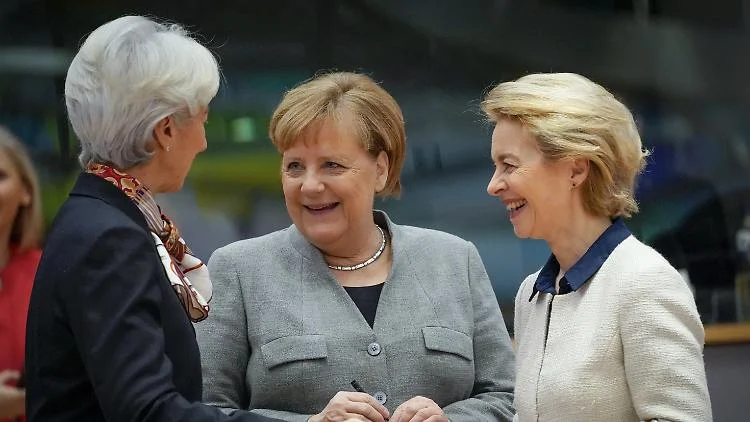
Angela, Christina and Ursula: Three Women Saving Europe
Periskopi(6 years ago)
(6 years ago)Paris Who was behind the drafting of a major economic recovery plan based on solidarity, against economic and social decay caused by a David-19 pandemic that threatened to inflict a fatal blow to the European Union? The answer lies in a three-way: Cristin Lagarde, Ursula Von der Lejen and Angela Merkel, [...]
Paris Who was behind the drafting of a major economic recovery plan based on solidarity, against economic and social decay caused by a David-19 pandemic that threatened to inflict a fatal blow to the European Union?
The answer lies in a three - part: Cristin Lagarde, Ursula Von der Lejen and Angela Merkel, 3 women with different personalities and backgrounds, but each in its main position, knew how to make the right decisions and at the right time.
The three women, in their 60s, did not expect to become the luminary <x0fant” of this delicate moment. Merkel was thought to be in her years of political twilight. Extinctly consumed after 13 years in power in Berlin, “decania” of European leaders had announced at the end of 2018 that it would give up a fifth term as German Chancellor.
Von der Lejen, who was elected president of the European Commission several months ago, was as young as Merkel, but the Chancellor had more experience. The unpopular German Defence Minister, who was imposed as chairman of the EU executive by heads of state and governments, received only a reserve support from members of the European Parliament.
Christine Lagarde was also completely foreign to the counties in Brussels, when it was proposed by Emmanuel Makron to be the head of the European Central Bank (ECB). The fact that she is a woman was significant in this selection, on behalf of gender equality for key positions in European institutions.
Former French Finance Minister had not previously run a central bank like its predecessors in Frankfurt; nor was he an economist. Would she know how to react to a crisis? It was Lagarde, who, after a mistake that served as a warning, placed on the first line of defence in the face of crisis.
On March 18th, the ECB president announced that she would start implementing a massive plan to support the economy. The Bank announced the purchase of 1,000 billion euros of government debt, and within months there was a strategy that was more ambitious than that of the U.S. Federal Reserve.
The goal was to ease the pressure on interest rates, and to stave off the risk of Eurozone fragmentation. The extraordinary “kohts, require extraordinary actions” she said at the time. The Central Bank stepped up its efforts in early June, granting an additional 600 billion euros.
Lagarde has learned the 2008 crisis lesson at the head of a central bank, which is now using all available resources. It took Merkel a little longer to react. But now, she is finally realizing that depression in developing economies will bring the countries of South Europe down on her knees, and may significantly threaten the Common European Market.
Pressed on its limits by Germany's Supreme Court, which questioned the legality of the European Central Bank's action, the French presidency urges the cautious and reasonable counterpart to act and break the taboo of financial solidarity.
Along with Emmanuel Makroni, it is already proposing a recovery fund of 500 billion euros, collectively borrowed from the European Union, and redociated from the EU budget to the most affected countries.
It was Merkel's strong turn, which will enable Von der Leyenne to play his role. The latter has not stood back since the beginning of the crisis, making constant calls for co-operation among member states, and introducing joint programmes for the purchase of protective medical equipment since late February.
Meanwhile on 19 March, he organised the creation of the first joint reserve in EU history of emergency medical equipment. While Paris and Berlin see fit to block mask exports, to avoid the disappearance of reserves for their countries, an empathic Ursula, apologised to Italians for the lack of solidarity and selfish reactions of member states.
Following the 18 May Franco-German deal, the European Commission, directed at Von der Lejen, significantly changed access by proposing a major economic recovery plan, and increased EU support to member states to 750 billion euros.
The plan laid the groundwork for a health union, proposing the protection of strategic European industries from foreign countries such as China, through state subsidies. Meanwhile, he mobilised funds for research on an available vaccine for all.
Each in its own field, and with a kind of humility, Christine Lagarde, Angela Merkel and Ursula Von der Lejen, have shown the added value of the European Union when it moves forward united, and driven by the same ambition. /
“Les Echos” World.al