40 minutes ago
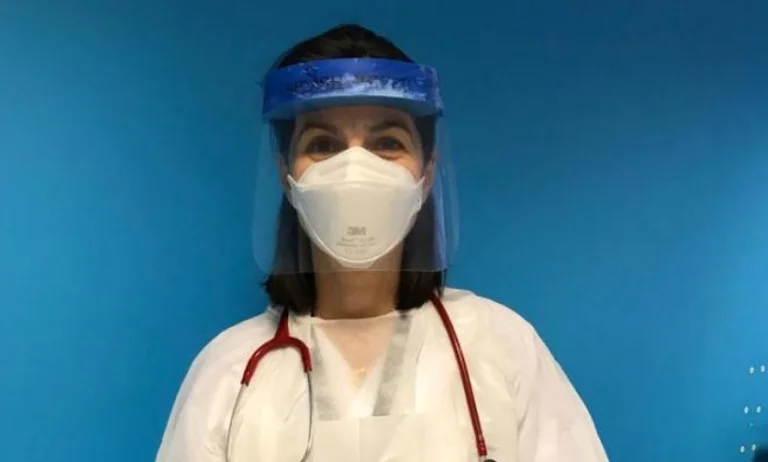
Albanian paediatrist in Brussels shows what Kawasaki is and how it's related to the Coronavirus
Periskopi(6 years ago)
(6 years ago)Albanian psychiatrist Valbona Selimaj-Conton, who has been living and working for six years at the CHAint Jean '%s' clinic, Brussels has talked about the character and consequences of Kawasaki disease, which appears to be accompanying a number of children with coronarys, and stops in the way parents can navigate to identify this disease. Graduate in [...]
Graduate of the Faculty of Medicine in Tirana in 2003, Valbona Selimaj completes master studies at the Public Health at Brussels Free University in 2005. After an experience with border-free doctor in Athens, he returns to Brussels, where he performs his specialisation for the Paddy. Dr Selimaj has also conducted specialisations for Clinical Nutrition and Infexology, Clinical Microbiology, as well as for pediatric Infexology at Oxford University.
Fuck.
Dr. Selimaj, what is Kawasaki's disease?
Kawasaki disease is one of the main causes of “disease acquired<x1nd of hearts in children. Clinical and epidemiological signs of this disease suggest an infexosis ethiology, but the cause remains unknown.
New York's Health Commissioner said Friday that if this disease is not identified early, it could have long-term consequences. The specific result?
Kawasaki disease is a vasculite - an inflammation of blood vessels - that can cause an extension of coronary arteries (heart - feeding arteries) if not treated in time. Kawasaki's disease was named after Japanese doctor Tomisaku Kawasaki, who was the first to describe the characteristics of the disease in children in Japan in the 1960 ' s. When the disease is known and treated in time, children have a very favorable evolution, and the overwhelming majority are completely healed. If the disease is not known and treated in time, and inflammation lasts, coronary arteries expand, and the child may have serious heart problems, such as thrombosis, a miocard heart attack, heart failure, and life risk.

It's said that Kawasaki is caused by exactly the coronary...
The origin of Kawasaki's disease (not to forget that it has been known since 1960) is not clear despite numerous studies. Some populations, such as Asian patients, have a greater tendency to become sick with this pathology. About 80% of the children affected are 3 months-5. There is a lot of hypothesis that Kawasaki (SK) disease comes after an infection that could be a/or some viruses or germs. During the acute phase of the SK many inflammatory cells invade layers of middle-sized arteries - especially coronary arteries. Then, if inflammation is not banned, the walls of the coronary arteries can be expanded and completely lost.
Since the end of April, the medical community in various Western countries has been communicating the growth of serious cases of children with toxic shock symptoms mixed with clinical signs of Kawasaki disease. This entity was temporarily appointed as Multisystemic Inflammatory Syndrome (SIMP) linked to the SARS-CoV2 infection. To date, some 230 cases of children affected have been reported in Europe. Of all these cases, three fatalities have occurred. We need to clarify that the cause-pass link between SARS-CoV-2 (Corona-virus) and SIMMP has not yet been proven and the signs of SARS-CoV-2 infection have not been found on all patients. Some children have found themselves infected in advance.
How can parents be instructed to identify this disease?
First, we need to be clear that this disease is very rare. Parents should not be alarmed. Usually, more frequent clinical signs are high temperatures for more than five days, conjutures (or eyeburning), rashing and cutting of lips and tongue, rashing the skin, zooming in on lymph nodes, handnails, or feet. Your child may present some or all of the above signs. The child does not feel well, and the parents usually understand. Parents need to contact their child if they are to see these signs in their own child. This text, however, has an informative character, and parents need to realize that not every temperature with leather rash in a child is a sign of Kawasaki disease. The diagnosis is based on many clinical elements in a detailed examination along with patient analysis.
You've personally encountered such a case?
I regularly see children affected by Kawasaki syndrome every year. Our last case was two weeks ago at the clinic where I work. The patient was completely healed.
Should parents be calm when it is said that children are less predisposed to be touched by the Coronavirus?
The anxiety our parents feel is understandable, given the gaps we have as a medical community regarding the new Covid-19 disease. In recent months, however, scientists in every corner of the globe are working to shed light on the various aspects of this disease, such as prevention, treatment, and meaning in the essence of its progress. Today we have enough data that can encourage parents with regard to the coronary infection in children.
The data reported on population studies, such as Iceland, Italy, China, Japan, is very encouraging to children about the risk of infection. So far, we can say that children become much less infected than adults, and they are far more asmitical. We should remember that even simple seasonal flu has a very high range on children. Kawasaki syndrome and Multisystemic Inflammatory syndrome related to SARS-CoV-2 are very rare manifestations.
We as parents, and as a society, we have to take care of our children and not neglect the psychic impact of pandemic on children. Let's try not to transmit our fears. Let us encourage and explain what we know about pandemic. They are locked up in apartments today, going back to school after a few months, and they have anxiety and depression, just like adults. The fact is, we as a society have globally overshadowed young ones and have very little to say about them these days.

How have you faced this unpredictable situation?
This period is challenging in personal and professional plans. I am very lucky that my husband (not a doctor) and my children are very supportive of my work. Professionally above all, there was a period of many readings of articles with new data. In the context of a new global disease that changed our lives to this degree, I believe that each doctor has felt more than ever the need to rely on scientific information to get the right answers. I had never changed so much correspondence with colleagues in other countries who had been ill with David-19 in front of us. Each data was “ard” to understand new pathology. Fear of life I have never felt at any moment despite the fact that I had the chance to examine infected patients. It is perhaps a way of looking forward. For loved ones.
What about quarantine? How did you spend your days out of everydayity in a normal period?
Karantina for me, like most doctors and medical staff, was half quarantine because I worked every day. I believe that at every difficult moment it is essential to make a decision to deal with the crisis. I made the decision to take advantage of my family, the main part of my life. We've never played so much with our children.