150 years ago, the excavations of ancient Troy began
 (6 years ago)
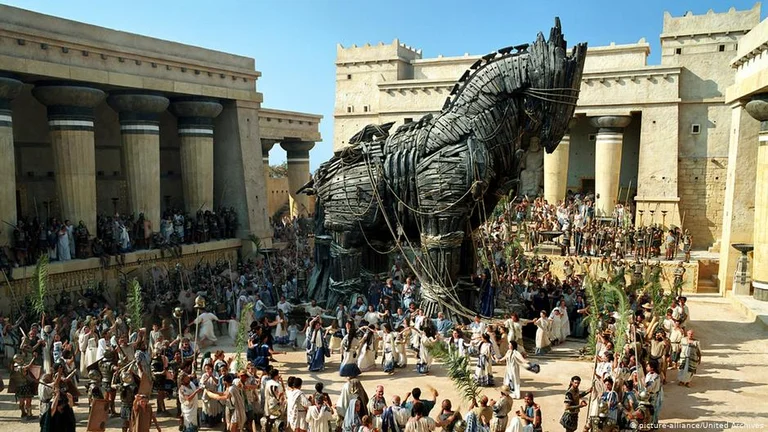
The story of the ten-year siege of Troy, of Helen's beauty, of the horse with which Greeks managed to defeat Troy, which describes the ancient poet Homer in his work „Iida“as drawing generations. Despite its gerographic position in Asia Minor, Troy marks the beginning of European history, prof says. Ernst [...]
The story of the ten-year siege of Troy, of Helen's beauty, of the horse with which Greeks managed to defeat Troy, which describes the ancient poet Homer in his work „Iida“as drawing generations.
Despite its gerographic position in Asia Minor, Troy marks the beginning of European history, prof says. Ernst Baltrusch of FU University in Berlin in conversation with DW. Homer's Ilyadia was of great importance in ancient times, and the enthusiasm of antiquity was broadcast through Greeks and Romans to this day. ”
Heinrich Schliemann was amazed at Troy at the age of his childhood. For 40 years he was convinced that the ancient city could not have disappeared completely and by 9. April 1870, he began digging for the discovery of the city's ruins.
Trader, adventurer, and archaeologist
The ancient world was his dream of life to adventure Schlimann. But his career began another course. He was born into the family of a pastor in Ostmecklenburg and had eight brothers and sisters. Because of the lack of financial means, Schliemann was forced to interrupt high school and went to Amsterdam to work as a business society. His gift of foreign language came to his aid, and within a year he learned Dutch, Spanish, Italian, and Portuguese, then Russian.

His linguistic skills were skillfully used by him, and from Amsterdam he moved to Russia, where he became rich in raw materials for weapons and ammunition. He then went to Paris to learn ancient Latin and Greek. A plot of a research trip, he went to Italy in 1868, where he began digging in search of the Odysse palace. From there he continued his journey to the Sea of Marmara.
Searching for Troy with “Iliada” in hand
Schliemann was a mixture of dreamer and genius. Dreamer because his journey in search of Troy only started through Turkey with Homer's “” in hand. Find out because he invented research methods used today at the end of the 19th century. However, the Germans for a long time did not appreciate his achievements.
Even today, Schliemann is often considered more of an adventurer than an archaeologist. On the one hand, because he had no problem with the tézi had completed the data he found with inventions that he created from his own mind and on the other side because he did not respect then the standards of archaeology, prof says. Ernst Baltrusch.
Schliemann's contestant, archaeologist Ernst Curtius, had no respect for him. Many researchers criticise Schliemann for letting workers dig deep holes, even though this has finally destroyed significant traces of Troy's antiquity. Schliemann's enthusiasm was well received in England, where the explorer, born on January 6, 1822 in Ostmecklenburg, is considered the inventor of mysterious Troy.
The War of Troy, Myth or Reality?
The search for Troy has continued for centuries. But no one has been able to testify if Homer's epos contained any truth about the war of Troy. The “that Homer wrote, and that Schliemann took as the basis for his archaeological discoveries, are to this controversial day”, prof says. Ernst Baltrusch. “We don't know if this war really happened. ” What made Schliemann important was that he learned ancient Greek to read “Ialada”, and on the basis of this book he set out to locate places that Homer describes. Schliemann himself considered the Battle of Troy to be”.
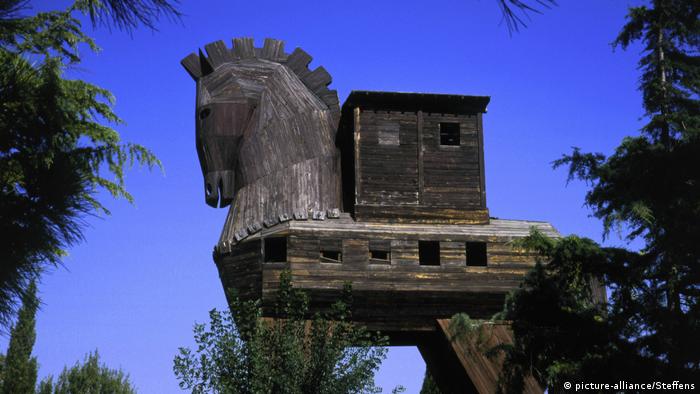
In 1871, Schliemann, then 49-year-old, met under Hisarlik Hill in Troas northwest Turkey in the supposed remains of the city of Troy. Heinrich Schliemann was not the first to assume that Homer's city described was located right there.
Bold walls, earthen vessels, and gold ornaments
Before the German Schlimman in this area, British excavations were conducted by Frank Calvert. He had even bought the earth around Hizarlik Hill, but he had no money to continue digging. Calvert and Schlimman met by chance. The long history of this ancient settlement, dating back to 3,000 pes. Until the Middle Ages, it made it difficult to identify archaeological findings at first. Calvert took Schliemann to continue digging where he had stopped.
At first, Schliemann found vessels that did not match Homer's descriptions. He then continued his excavations, revealing the several-foot-high remains of ruins of the prehistoric city destroyed. And in 1872, Schliemann and his assistant Wilhelm Dörpfeld were sure that the thick walls they had dug were part of Troy's fortifications.
One of his most important findings was that of 1873, the golden “thesary of Priam”, as he baptized Schliemann. He smuggled it out of the country and gave it to the Germans. In the riots of World War II, the treasure ended up in Russia, and for years it was considered extinct. Today he is preserved at the Pushkin Museum in Moscow.
Not Agamemnon mask
Unfortunately, Schliemann was wrong with his assumption. The golden treasure he found was not Priam's but belonged to an unknown high culture, which is about 1250 years older than Troy. Even in Miken, where Schliemann conducted excavations from 1874 to 1876, he again made a mistake in interpreting a golden mask. The mask he found there did not belong to the commander, Shoenas Agamemnon.
However, descendants have forgiven his mistakes. Heinrich Schliemann died in Naples on December 26, 1890, and is honoured today worldwide. Despite his archaeological methods, Schliemann's name is forever linked to the name of Troy”, says historian Ernst Baltrusch. “due to its excavations for Troy, he is certainly the world's most renowned archaeologist”