2 minutes ago
Who should invite political leaders to the meeting?
Periskopi(6 years ago)
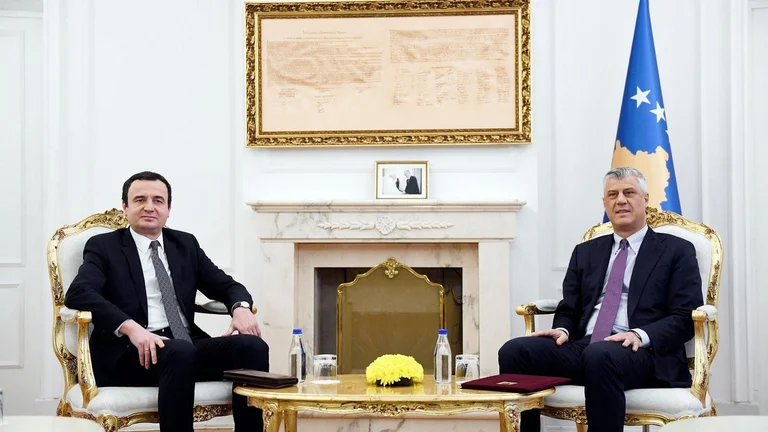
(6 years ago)The call of a joint meeting of all institutions and political parties in Kosovo has deepened the race for political prims between president Hashim Thaci and Prime Minister Albin Kurti. At this meeting, the two institutional leaders are claiming to talk about Kosovo's representation in the process of political dialogue with Serbia. [...]
Prime Minister Albin Kurti has already launched invitations to all leaders of institutions and those of the ruling and opposition political parties to meet and discuss dialogue. But, even President Thaci has stated that he will invite political leaders to a meeting to discuss the possibility of unifying political positions for dialogue with Serbia.
Such initiatives, seen as also a race to get political primat, according to political analysts in Pristina, are damaging Kosovo's position in dialogue and foreign policy.
Political analyst Albert Krasniqi told Radio Free Europe, that currently in the political spectrum, there is a extreme polarisation seen on both the level of institutional leaders and within the ruling coalition partners.
And why these within the country are happening, it's also about a lack of respect for the constitutional tasks that have institutional leaders. So there is a tendency to take on more power than the Constitution has guaranteed I am talking about the aspect of foreign policy”, Krasniqi said.
The constitution of Kosovo, but also the Constitutional Court, according to Krasniqi, has clarified who should lead the dialogue process as well as foreign policy.
The second “, who should be the person who will invite leaders for a unity here, it would be necessary that the country's president, who has a mandate to represent a unity of the people, be the figure that unifys the entire political spectrum, and not the figure that contributes to the further division”, Krasniqi said.
Meanwhile, Life Krasniqi, analyst from the Kosovo Democratic Institute, tells Radio Free Europe that the question of who can invite leaders for a unity to a meeting seems like technical problems, if compared to how important it is to act more quickly in this direction.
“We must withdraw from statements for internal consumption daily, from the internal policy race and have a focus of institutional leaders towards building a unity, a clear strategy of the state of Kosovo, as in talks with Serbia or foreign policy”, she said.
According to jetai Krasniqi, the leadership in Kosovo, he continues to be focused on providing political points for himself, failing to respect each institution's competencies and meeting its responsibilities.
The “Liders can gather (at a meeting) each, even the president. We have also seen in the past that the president has invited party leaders to various issues, to perhaps overcome the political crisis that were produced by political parties. We know that the presidential institution is the one that represents the unity of the people and that should ensure the functioning of constitutional institutions in the country”, Krasniqi said.
According to analysts, it would be desirable for Kosovo to have a unified position and a comprehensive team in the final phase of talks with Serbia.
The process of dialogue between Kosovo and Serbia, facilitated by the European Union, which is said to have normalisation of reports and reaching a peaceful agreement between the two countries, is currently blocked. Since November 2018, when the Kosovo government imposed 100 per cent customs duties on imports from Serbia and Bosnia and Herzegovina, Belgrade has no longer agreed to sit at the negotiating table.
Since the European Union has not given any clear signal to the continuation of dialogue, the United States of America has increased their commitment to this process through the White House's envoy for dialogue, Ambassador Richard Green.
But, even in this case, it is required that the Kosovo government initially abolish the customs duty on imports from Serbia. Such a request, Kosovo Prime Minister Albin Kurti has responded with the proposal for partial abolition, step by step, beginning with the removal of tariffs for the first subject imported from Serbia, starting 15 March. Kurti has declared that if Serbia would stop the campaign against Kosovo independence, then the tax would be completely lifted by April 1st.