10 hours ago
Where Women Pay to Grieve
Periskopi(6 years ago)
(6 years ago)Oil women guard an old tradition in Greece. The work they do by grieving over a horinary is more current today than ever, photographer Ionna Sackalaki thinks. When Ionna Sackallaki lost her father, she who lives and works as a photographer in London returned home to Greece. She wanted to stay [...]
Oil women guard an old tradition in Greece. The work they do by grieving over a horinary is more current today than ever, photographer Ionna Sackalaki thinks.
When Ionna Sackallaki lost her father, she who lives and works as a photographer in London returned home to Greece.
She wanted to stay there for some time to process the pain and spend time with her mother.
In the effort she was making to understand her pain, she faced traditional rituals of Greek culture related to death.
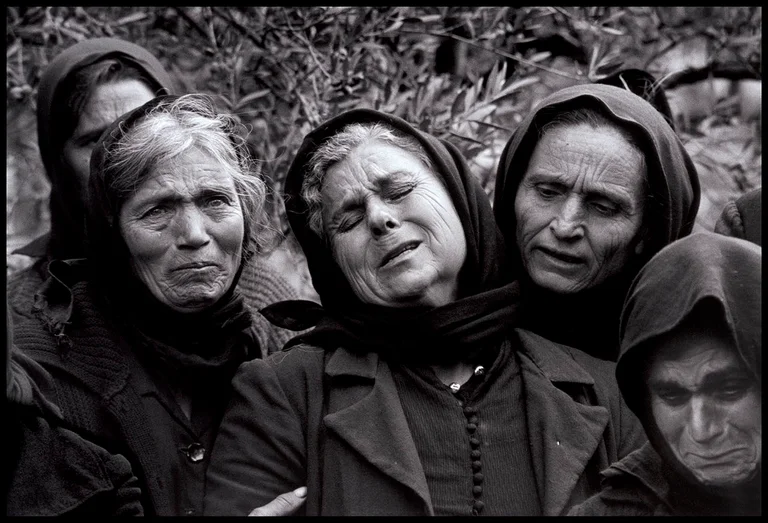
She thus learned about a group of elderly women who live in the remote villages of Peloponnese and still do an old trade - weeping over a hotries.
Guided through the cult of the dead
Moirologists are called these women: “Moíra” means luck and “lógos” means language.
They are required to sing and mourn at burial ceremonies in Greece, thus introducing families to complex rituals of traditional Greek death cults.
The mourners are commissioned to mourn over someone they have never met. Just as mourners have done before them for centuries.
Ioanna Sackallaki was fascinated by many.
After receiving a scholarship from Londoner Royal Photographic Society, 31 - year - old girl went to the villages where these women are located to learn more about this old trade.
Her project under the name “The Truth is in the Soils” (“The truth is on earth”) documents the life of several moirologists.
These photos were shown during October at an exhibition in Berlin, in the context of the “European months of photography”.
The tradition of fate “=x1>
The mourning tradesmen on the Mani Peninsula understand their work as work to help families in their mourning and to accompany the dead on the road to the next world.
The oils they sing are called the “Book of Fate”, says the photographer, who is protecting the doctorate in philosophy, Sacelak when she speaks of Deutsche Welle. “They come from an old tradition and they're some kind of oral implantation”.
From a historical point of view, says Sacklaraki, <x0-family paid these women for this process, because for them it was important, it was a kind of important collective separation from the person”.
Moirology is based on the choirs of ancient Greek tragedies, on which the lead singer begins the oil, which is continued by the choir.
Over the centuries, this trade has been made only by women.
Evidence of professional burial mourners is also found in ancient Egypt, where two women who played the role of the Sisters Isis and Nephtys helped prepare the dead.
mourning talk is given in Germany
A professional and adjective complainer has today around the world, but it must be said that they exercise their profession quite differently, depending on cultural context.
Germany engages people who give a talk, remembering the dead when the funeral ceremony is performed without religious association.
In parts of Africa, professional people are paid to shed tears.
The novel “Death Roads” of South African writer Zakes Mda tells the story of a professional oiler, Toloc, dating from one barac colony to another in apartheid's time in South Africa.
In Rajasthan, India, there is an exploitative tradition where women of lower classes who work for wealthy men and express their pain, which is not acceptable to family members because of the class.
“There are people who cannot cry”
There is a long history of professional mourners in China, starting in the Han Dynasty period.
In recent years this type of profession has been restored to life, while during the cultural revolution it was banned.
Professional murmurers in China today offer only tears and mourning over the dead as well as emotional honors or theatre performances to alleviate the atmosphere of the mourning community.
One of the country's most famous professionals, Hu Xingljan, explained a report of the American radio station NPR: that “there are people who are unable to cry. So I offer my heart to sing the song that presents the younger generation loss”.
Rivally wailing Shows Something Different
The use of the theater as a means of showing emotions is still present in Greek tradition.
Man's murmurers do not put tears on the ground like Chinese colleagues, but they dress in black and wear embroidered headscarves, which gives them a theatrical character.
These women become death agents within a community of”, relates Ioanna Sackallaki. “They must appear and play” in a certain way.
Their presence and song enable the family members of the deceased to express their emotions and pain openly, not hide them.
This means that the idea of cleanliness, of catharsis in Greek culture comes from this ritual”, complements the photographer.
Black in the Times of Coronavirus
November 15th is Germany's national day of remembering the dead. The subject of death is more troubling to society today than ever because of the COVID -19 pandemic.
Hence, studying mourning rituals in the mourning process is more important than ever.
But it is in personal and private rituals, although they are important, that they cannot be regarded as usual because of the rules of distance and hygiene.
The tradition of moirology on the Greek peninsula Mani is in danger of losing quickly, despite the coronavirus.
Many women who have photographed Ioanna Sackallaki are nearly a hundred years old. And so far none of the younger generation has taken their place. But maybe their songs will survive.