2 hours ago
Albanians lose hope of better future in their country, 29% more asylum applications

Periskopi(7 years ago)
(7 years ago)The Albanian's desire to leave has returned strong in the first part of this year, as amid the prolonged political crisis, people do not seem to be seeing light for their own future in the country. The latest preliminary data published by AESO, the European Office of Asylum Support, and of [...]
The Albanian's desire to leave has returned strong in the first part of this year, as amid the prolonged political crisis, people do not seem to be seeing light for their own future in the country.
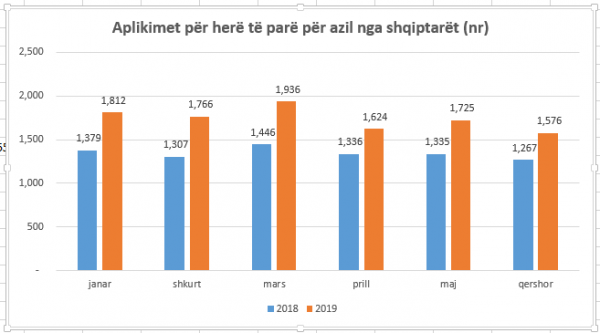
The latest preliminary data released by AESO, the European Office of Asylum Support, and processed by the Monitor, indicate that in the first six months of the year, there were 10,439 asylum requests for the first time by Albanians in one of the European Union countries.
In proportion to the same period a year ago, asylum demands have increased significantly by 29.3%. In June alone, there were a total of 1,787 applications from Albania, of which 1,576 were for the first time and 211 were repeated applications. In relation to other Balkan countries, Albanians hold the record in their desire to leave.
From Serbia, there were 352 applications in total, from northern Macedonia 192, from Bosnia 122, from Kosovo 273, and from Montenegro there were only 19 applications, broadcast “Balkanweb”.
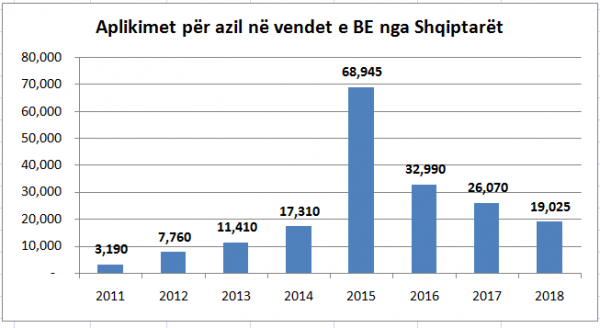
In 2015 a significant increase in asylum demands by Albanians was found, reaching a total of about 69 thousand, from 17 thousand the previous year. Then their number came down gradually to reach 19,000 in 2018 (see the graph: Applications for asylum in EU countries by Albanians.
But the first months of 2019 are talking about a strong revival of immigration, in a signal that should serve as alarm for policymakers, to take this phenomenon seriously and turn back hope for the future of the country. A recent study by the Centre for Economic and Social Studies found that 70% of young people studying at Albanian universities aim to leave the country.
The new immigration profile after visa liberalisation has included all population age groups in all of the country's cities, leading towards quick emptying, but recently, well-qualified staffings working in value-added companies and high salaries. In 2007, about 40% of highly educated people wanted to leave the country. In 2018, this trend has increased by 13 percentage points, since 53.7% of highly educated people have claimed they are planning to leave the country.
Albanians refused
Albania is cited in the AESO report as one of the countries that has been contributing to increased demand by states that have access to Schengen visa-free travel in the first half of the year, along with Georgia.
The asylum requirements are high by Albanians, though rejections for them are high, as our country is considered secure and integration is under way to join the European Union. In June, out of the 1700 verdicts that were made for Albanian applications, 94% were negative, one of the highest rates of rejection in the world. For the January-June period, there were a total of 10,758 rejections for the applications of Albanian citizens. In total are 11.3 thousand cases still pending.
EU asylum requirements rise 10% in first half 2019
Approximately 337,200 applications were carried out in total in the EU + 1 in the first six months of 2019, with 10% growth compared to the same period a year ago, according to the ESAO report.
In June, citizens of Syria, Afghanistan and Venezuela continued to file more asylum demands, though declining compared to May.
Similarly, citizens from Iraq, Colombia, Pakistan, Albania, Turkey, Nigeria and Iran also submitted a significant number of applications, but declining in relation to May; this was especially true of Nigerians (- 30%) and Iranians (- 25%). However, for the most part these states have submitted more applications so far in 2019 compared to the first half of 2018; this was more evident to Albanians, Turks, Iranians and Palestinians.
Citizens of countries exempted from visa requirements when entering the Schengen area have scored an increasing number of applications. Applications from this group reached a new record in the first quarter of 2019, accounting for about 27% of all applications submitted to the EU +; this burden was only 18% in the two six-months of 2018.
The increase was driven by the high number of applicants from Latin-American countries, but also by Georgia and Albania.