a minute ago
Vetevendosje launches political activity in Albania: Resigned

Periskopi(7 years ago)
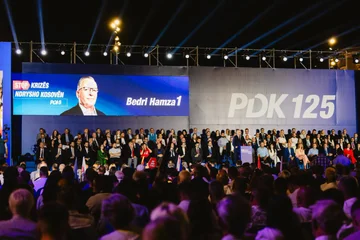
(7 years ago)The Vetevendosje Movement in Albania has started its political activity only recently after it opened its branch there. For the VV, the crisis in Albania is not between opposition and position, but it is a general economic, social and institutional crisis. Read below the complete communique: Power in the Republic of Albania has abused [...]
For the VV, the crisis in Albania is not between opposition and position, but it is a general economic, social and institutional crisis.
Read below the complete communique:
Power in the Republic of Albania has abused the mandate given by citizens. Growth in poverty and inequality has responded with arrogance and violence. The inability has attempted to cover it with marketing and media control, and no longer accounts. The demand of students for quality and free higher education, based on education as a right, has been answered with the cartoonisation of some points that do not change the core of the problem. The Albanians' aspirations for national union have responded with acceptance of plans for partitioning Kosovo, never distanced from Aleksandar Vucic's project and Hashim Thaci, and with the deployment of a second border: tax beam on the nation's road. Protests against this tax have responded with preparation for putting new taxes on other country road premises. While the promise of a unified Albania-Kosovo market has been winked at. Recently, he has even given his kick to parliamentarians, trying to create a formal opposition that controls him.
The crisis in Albania is not between opposition and position, but is a general economic, social and institutional crisis. Albanians are not blind. It is clear that the opposition, which has earlier agreed to change the electoral system to ensure the eternity of the two parties that have been ruling Albania for nearly 30 years with the treatments of a neo-feudadal system. It is understandable, therefore, why during student protests, the students kept the parties at bay. These political parties have abandoned many of the causes they have supported, and they do not enjoy the trust of citizens. But citizens have already made it clear with their participation in protests that the status quo is no longer acceptable. Anyone who does not see this legitimate demand of citizens is not feeling or understanding the critical moment in which the country is located.
Deep and broad reforms in the Albanian state and society are needed. So essential they must be, that before we can talk about reform necessary transformation. There is no legitimate reason why the electoral system in Albania is not proportional national, with open lists, as is Kosovo. Thus, citizens could choose candidates themselves inside the lists, both counterweight and lack of internal democracy in political subjects in Albania, where the party's first decides almost everything. The economic model, should be directed towards production, protecting workers' rights and re-establishing trade unions that engage without compromise for these rights. Albania desperately needs a government based on the principles of democracy and accountability, fighting the extreme inequalities that have been created. Many rulers, before giving up official office, have to take their foot off the people's neck. This is not a democracy or a Republic. The Albanian state is violating its subjects and disappointing Albanians abroad.
Admittedly, the Socialist Party is not in power, as the country is run by a click of politicians and Tajkun who count on fingers. This line runs in the opposite direction with developments in Social Democrat parties in Europe. We should set the example of the Labusist Party in the United Kingdom, which has given up slogans such as “beyond left and right”, which repeated its previous leaders, and has already returned to Socialocracy through the fight against inequality for the majority, and not for privileges for the minority. With the political programme established on social justice, it has markedly increased citizens' support.
In the EU states, resignation has been given for much less than what power did in Albania. In Austria, Prime Minister Sebastian Kurz, and in the United Kingdom, Prime Minister Theresa May both resigned recently. The first because of a corruption scandal by his coalition partner, the second because he failed to finalise the project he supported. Both of these politicians had won majority votes to govern the country, but did not hide behind numbers for their disabilities. They took political and moral responsibility by committing an emissary act of resignation.
The opposite is true in our country, where they are used by epithet authorities as <x0). In fact, to retain power and divide citizens, they have attempted to increase the discrimination of Albanians on the basis of geographical background, showing a completely provative and clanistic thinking in the country's direction.
Albania can't go on like this. Albanians deserve leadership and progressive economic and political programmes. Let the change begin with an emissary act as resignation.