Hashim Thaci's 20-year returns

 (8 years ago)
Two years of KLA reformed in military and political roles, two mandates out of power, three unfinished mandates in power, until eventually came the head of state in the alleged role of the communicator, which he still holds today. These are the 20 years of the man who, known by the nickname of war “Jarpri”, already [...]
Two years of KLA reformed in military and political roles, two mandates out of power, three unfinished mandates in power, until eventually came the head of state in the alleged role of the communicator, which he still holds today.
These are the 20 years of the man who, known by the nickname of war “Gjarpri”, is now the longest-lived politician on the Kosovo stage, with movements that often made it controversial and sparked debate inside and outside of Kosovo.
But what was the figure of the student of history over two decades?
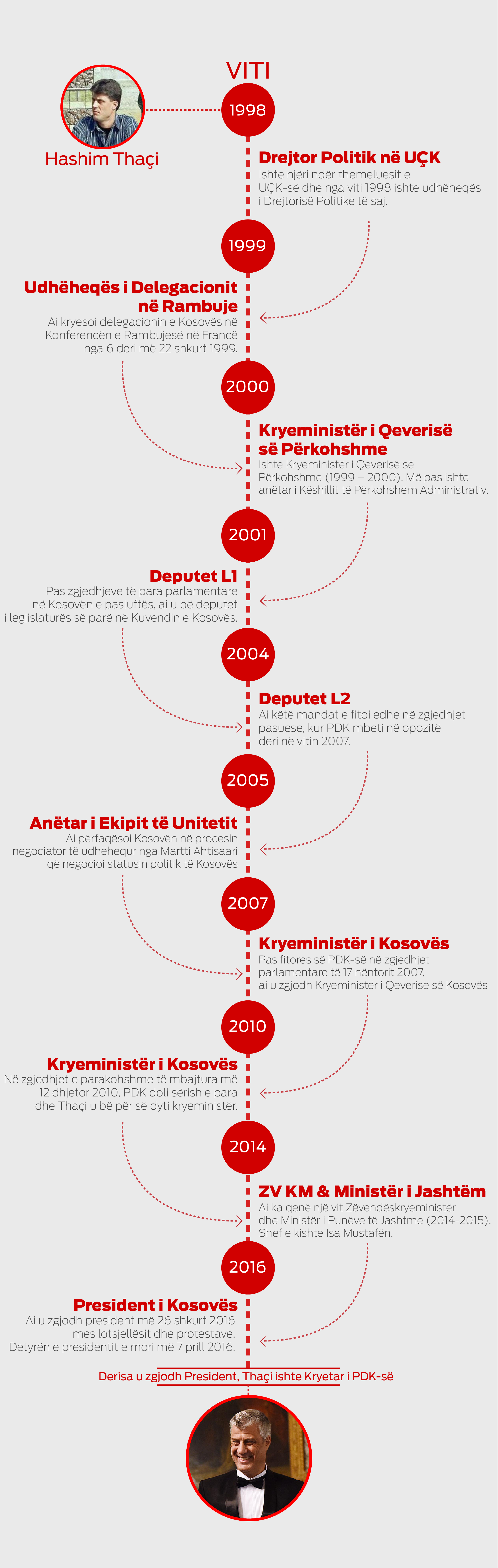
Born on April 24, 1968, in the Skywright Bureau, Hashim Thaci, his political activity had started as a member of a military group. He in 1998-99 was the KLA's Political Director of General Staff.
But Thaci would become widely known to the public only when elected as political representative The KLA would lead the Albanian delegation to the Rambouillet talks.
Here for the first time, the openly disincentives between him and Ibrahim Rugova, this rivalry that would last until the death of the latter, which would pave the way for power that never left him again.
After the war ended in Kosovo, Thaci led the process of disarming the KLA and transforming it into the KPC, but failed yet to transform the KSF into Armed Forces, even though he had promised it decades.
In October 1999, he founded the Party of Democratic Progress of Kosovo, while in the First Election Assembly (2000), Thaci is elected head of the Democratic Party of Kosovo, to which he changed his name and continued to lead until the election of president.
Hashim Thaci was prime minister of the Kosovo Interim Government from March 1999 to January 2000, when he lost his local elections. A year later, The PDK led by him also lost in national elections.
Gradually, the power of political subjects in the country took shape, with the LDK at total dominance at both levels of governance as the impatience of Hashim Thaci's PDK to take power was growing.
The man who had been at the helm of the KLA did not receive civic confidence, for which he was forced to remain in opposition for eight years in a row. For those two terms, he was deputy of the Kosovo Assembly.
In 2005, Thaci formed and directed the so-called Cabinet for Good Governance, or as the Government in the Shadow was known.
Meanwhile, he was part of the Unity Team during talks in Vienna on the election of Kosovo's final status.
After Rugova's death in January 2006, his biggest political rival, Thaci, would completely change his approach to his image.
The LDK breach, which preceded its historic leader Ibrahim Rugova's death, paved the way to Thaci's power.
Although he had once accused Rugova, especially after his meeting with Milosevic, he now expresses condolences for him, bows to his grave, and visits his family at the house that when Rugova was struggling with the deadly disease, he had called “the home of the crime”.
The LDK breach, which preceded its historic leader Ibrahim Rugova's death, paved the way to Thaci's power.
In the December 17th 2007 parliamentary elections, PDK came first, and as coalition candidate PDK HINA LDK, Hashim Thaci, became prime minister for the first time.
After exactly two months of assuming the prime minister post, Thaci read the declaration of Kosovo's declaration of independence. The circumstances leading up to the definition that Thaci as prime minister will read this statement remain unclear.
But, nearly three years later, in October 2010, the coalition The PDK HINA LDK collapsed after the Constitutional Court found President Fatmir Sejdiu in violation of the Constitution, simultaneously holding the post of president and that of the LDK chairman. Although the second post had been declared frozen long ago.
Sejdiu's resignation from the presidency turned him into the party headquarters, which, a few days later, decided that LDK ministers would withdraw from the government-led Hashim Thaci.
In the following elections, Thaci found another governing partner, Behgjet Pacolli's AKR, which originally made the president, but following another Constitutional Court decision that led him to resign, he returned to the government cabinet to the post of deputy prime minister.
In June 2014, in the early elections prompted by Thaci, his party again came first.
In December of that year, Thaci gave the executive chief's position over to him Isa Mustafa, while for himself, took up the post of deputy prime minister and minister of foreign affairs as the transitional phase of his establishment at the head of state in April 2016, when Atifete Jahjaga ended the mandate.
But after 16 years in politics, he was eventually taken out of party politician's clothing to be elected president of the country, even though his election at the head of the state was accompanied by protests and tear gas. Today it numbers up to two decades on the political scene.
Throughout this time, he had given many promises, which he had not rarely kept.
Following the failure of the Special vote in June 2015, Thaci pressured his deputies to vote on the same amendments on August 3rd of that year. But, last week of December last year, he backed the idea of abolishing this court. Then he withdrew, but only after international pressure.
This was not the only time Thaci did not sit behind words.
His promise of transforming the KSF into the army was postponed year-on-year, not yet to become reality.
With Thaci prime minister, foreign affairs minister and now president, Kosovo remained an isolated country, without visa liberalisation, even though it promised it several times.
Hashim Thaci also promised to sue Dirk Martin, the author of a Council of Europe report that brought Kosovo into the forefront of international media with negative news, but he never did.
In the president's role, he has taken over to lead political dialogue with Serbia, the process that had started as prime minister. Even the so-called prehistoric agreement aims to sign it itself.
The transformation of it over the years by an idealistic nationalist into materialistic progragatists, analyst Behlul Beqaj had summed it up in a sentence
“From Hashimi that I announced at the first meeting, there is no H- of him, said Beqaj.